Dental appointments in Meenchanda, Kozhikode Contact Now
Endodontics · Kozhikode

Root Canal Treatment in Kozhikode Saving the Tooth Instead of Losing It

Carried out by MDS qualified endodontic specialists at Adhithi Poly Clinic, Meenchanda. Single sitting RCT available for clinically suitable cases.

MDS endodontic specialists Single sitting where suitable Adhithi Poly Clinic, Meenchanda
Honest answers

Will it hurt, and is it worth it?

Almost everyone who is told they need a root canal asks the same two questions: will it hurt, and is it worth it compared to just taking the tooth out? Here are the honest answers.

Question 01

Will it hurt?

A root canal is carried out under local anaesthesia. Most patients report that the procedure itself feels comparable to having a filling done. The pain people associate with root canals is nearly always the pain of the infection that made the treatment necessary in the first place — which is exactly what the procedure removes.

Mild soreness for a day or two afterwards is normal and manageable.
Question 02

Is it worth it?

And it is worth it. Your natural tooth root holds your jawbone in place and keeps your bite aligned. Once a tooth is removed, that bone begins to change, adjacent teeth drift, and you are eventually looking at an implant or a bridge — a longer and more expensive road than the one you were trying to avoid.

Where a tooth can reasonably be saved, saving it is almost always the better decision.

At Adhithi Poly Clinic, root canal treatment is performed by our specialists in restorative dentistry and endodontics — dentists with MDS level training specifically in this procedure — rather than by a general dentist. Treatment suitability and outcome depend on your individual clinical condition and are confirmed at assessment.

MDS endodontists Specialists in restorative dentistry and endodontics, not a general dentist.
in-house radiology Oral radiology support when the canals or the infection are complex.
Council registered All our dentists are registered with the Kerala State Dental Council.
When a root canal is needed

Signs You May Need Root Canal Treatment

These are the changes patients usually notice first. A tooth can also need treatment with none of them — the note below explains why an X-ray still matters.

01

Persistent toothache

Persistent toothache, particularly pain that worsens when you lie down.

02

Lingering sensitivity

Prolonged sensitivity to hot or cold that lingers after the source is removed.

03

Pain on biting

Pain when biting or applying pressure to a specific tooth.

04

A darkening tooth

A darkening or discolouration of a single tooth.

05

Swelling near the tooth

Swelling or tenderness in the gum near a tooth, or a small pimple like bump on the gum.

06

Deep cavity or crack

A deep cavity or a cracked tooth, whether or not it currently hurts.

The procedure

How Root Canal Treatment Is Carried Out

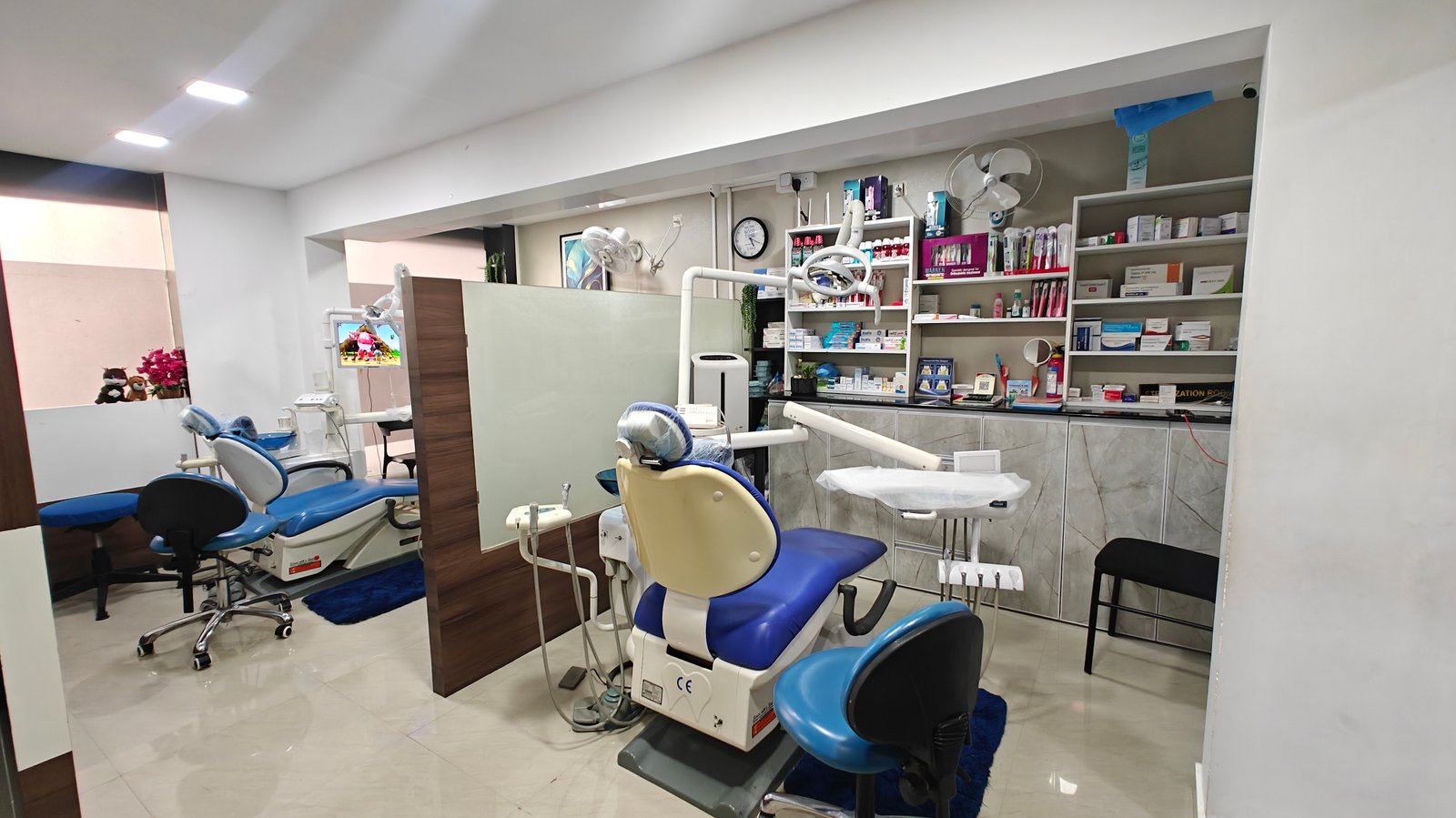
Bright dental clinic interior prepared for treatment Assessment and imaging come first
01

Assessment and imaging

An X-ray shows the extent of the infection and the shape of the root canals. Our in-house oral radiology specialist supports diagnosis where the case is complex.

02

Anaesthesia

The area is fully numbed. You should not feel the procedure. Tell your dentist immediately if you do.

03

Accessing and cleaning the canal

The infected pulp tissue is removed and the canal system is cleaned and shaped.

04

Disinfection and filling

The cleaned canals are disinfected and sealed with an inert filling material.

In most cases 05

Crown or restoration

A treated tooth becomes more brittle and usually needs a crown to protect it from fracture. This is not optional in most cases — skipping it is the most common reason a root canal treated tooth is eventually lost.

One visit, when it is appropriate

Single Sitting Root Canal Treatment

Some root canals can be completed in a single appointment rather than across two or three visits. This suits patients who travel from outside Kozhikode or cannot take repeated time off work.

Single sitting RCT is an option for clinically suitable cases — not every case. Whether it is appropriate for you depends on the level of infection present, the anatomy of your root canals, and whether the tooth is currently symptomatic. Cases with active acute infection or complex canal anatomy generally require more than one visit for a sound result. Your endodontist will tell you which applies to your tooth after assessment, and will not compress treatment into one visit where doing so would compromise the outcome.

Cost, explained

What Affects the Cost of a Root Canal

We do not publish fixed prices, because the honest answer is that root canal cost varies with the case. The factors that determine it are:

01

Which tooth it is

A front tooth typically has one canal, a molar can have three or four, and the work involved differs accordingly.

02

First treatment or retreatment

Whether the case is a first time treatment or a retreatment of a previously treated tooth.

03

Number of sittings

The number of sittings clinically required.

04

Crown or restoration

The type of crown or restoration placed afterwards — for example, metal ceramic versus zirconia.

05

Additional procedures

Whether any additional procedure, such as a post and core, is needed.

The full figure, before anything starts

You will be given the full cost of your treatment, including the crown, during your consultation and before any work begins. There are no figures added later.

FAQ

Questions people ask before a root canal

Pain, time, single sitting treatment, crowns, extraction and who carries out the procedure at Adhithi Poly Clinic.

Still unsure about your tooth?

Root canal treatment is carried out under local anaesthesia, and most patients describe the procedure as comparable to having a filling placed. The pain commonly associated with root canals is the pain of the underlying infection, which the treatment removes. Mild soreness for one to two days afterwards is normal and usually managed with ordinary pain relief.

A single appointment generally runs between 45 and 90 minutes depending on the tooth. Treatment may be completed in one sitting or across two to three visits, depending on the level of infection and the canal anatomy. Your endodontist will confirm this after assessment.

Single sitting root canal treatment is well established and is an appropriate option for clinically suitable cases. It is not suitable for every tooth — cases with active acute infection or complex canal anatomy usually need more than one visit. Suitability is determined by clinical assessment, not by patient preference.

In most cases, yes — particularly on back teeth. A tooth that has had root canal treatment loses its internal blood supply and becomes more brittle, and a crown protects it from fracturing under chewing force. Skipping the crown is the most common reason a successfully treated tooth is later lost.

Rarely. A natural tooth root maintains the jawbone around it and keeps your bite stable. After extraction, bone in that area changes and neighbouring teeth may drift, which often leads to an implant or bridge — a longer and more costly route than the root canal it replaced. Where a tooth can reasonably be saved, saving it is generally the better clinical decision. Where it cannot, we will say so plainly.

Root canal treatment is performed by our MDS qualified specialists in restorative dentistry and endodontics, supported by in-house oral radiology for diagnosis. All our dentists are registered with the Kerala State Dental Council.

Adhithi Poly Clinic, Meenchanda

Save the tooth. Start with an assessment.

Your endodontist will confirm whether the tooth can be saved, whether one sitting is appropriate, and the full cost — including the crown — before any work begins.

Call9747773866
Book Call WhatsApp